
Introduction
Ever wondered how to tell if a coin is valuable? You’re not alone. Many beginners get into coin collecting after noticing a strange date or mint mark and realizing it might be something rare. In this guide, we’ll break down the basics—from spotting mint errors to understanding how condition and grading affect value—so you can evaluate your coins with more confidence.
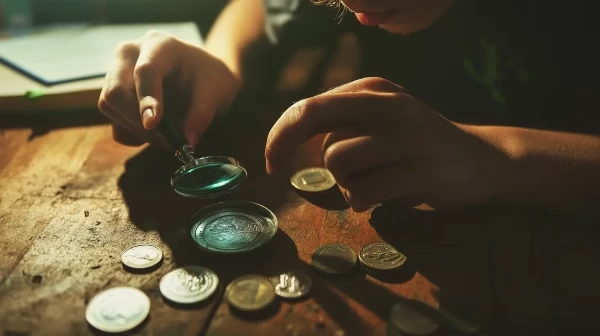
How to Tell If a Coin Is Valuable: 5 Key Steps
Valuable coins stand out due to specific characteristics: rarity, mint marks, errors, and condition. These factors determine whether a coin is worth a few cents or a small fortune. For beginners, understanding these elements is the foundation of spotting hidden gems. Rarity reflects how scarce a coin is, often tied to low mintage or historical events. Mint marks reveal where a coin was made, impacting its value due to production differences. Errors, like doubled designs or misstrikes, can make a coin uniquely valuable. Finally, condition—or how well-preserved a coin is—plays a major role in its worth, as collectors prize coins in excellent shape. By mastering these factors, you’ll develop a keen eye for value, turning everyday coins into potential treasures. Let’s break down each step to help you get started.
Step 1: Understand Rarity
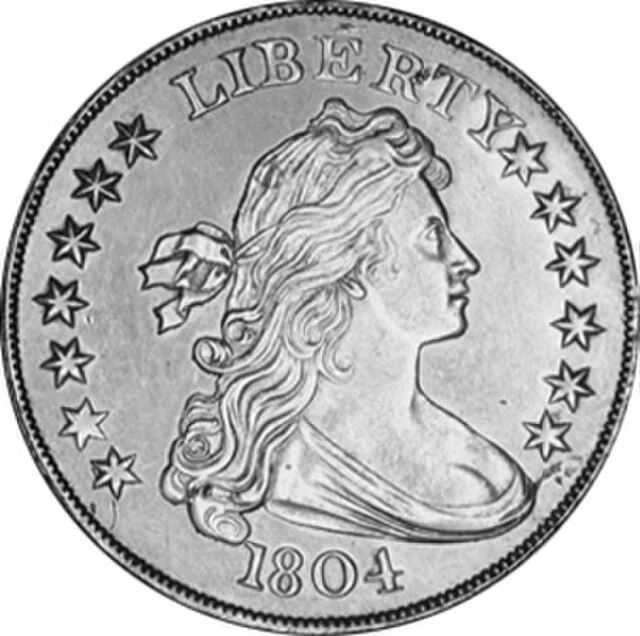
Rarity is the foundation of a coin’s value. A coin is rare if only a small number were minted or if few have survived over time. For example, the 1804 Draped Bust Dollar, often called the “King of American Coins,” is incredibly rare, with only 15 known examples, making it worth millions—one sold for $7.68 million in 2021. Despite its date, most were minted in the 1830s as diplomatic gifts for foreign dignitaries during President Thomas Jefferson’s administration, adding to its historical significance. The coin features a draped bust of Liberty on the obverse and a heraldic eagle on the reverse, a design that reflects early American artistry. While you’re unlikely to find an 1804 Draped Bust Dollar in circulation, its story highlights why rarity matters. The image I selected for this section captures its intricate details, helping you visualize what makes such a coin a collector’s dream.
As a beginner, you can look for more accessible rare coins with low mintages. The 1909-S V.D.B. Lincoln Penny, with a mintage of just 484,000, is a great example—it’s worth $600-$1,000 in Good (G-4) condition. Minted in the first year of the Lincoln Penny series, it was designed by Victor David Brenner, whose initials “V.D.B.” on the reverse caused controversy, leading to its limited production. Another example is the 1921 Peace Dollar, with a mintage of 1,006,473, worth $100-$150 in circulated condition. Introduced to commemorate peace after World War I, its high-relief design made production challenging, contributing to its scarcity. I once found a 1921 Peace Dollar at a local coin shop for $120—knowing its rarity made the purchase a small victory.
How to Check for Rarity: Research the mintage numbers of your coin using books like the Red Book (A Guide Book of United States Coins), which lists production figures for U.S. coins, or online databases like Numista for international coins. Coins with mintages under 1 million are often worth a closer look, though survival rates matter too—many older coins were melted down or lost over time. For instance, in our post “Rare US Coins 2025: Top 10 Worth Money,” we highlighted coins like the 1916-D Mercury Dime (mintage: 264,000, worth $1,000+ in Good condition), which is rare due to its limited production during a transitional period for U.S. coinage. You can also check auction records on sites like Heritage Auctions to see what rare coins are selling for—seeing a 1909-S V.D.B. Penny sell for $800 inspired me to hunt for one in old penny rolls.
Step 2: Check for Mint Marks
Mint marks are small letters on a coin that show where it was minted, and they can significantly impact its value due to production differences across mints. For example, a 1965 Canadian Silver Dollar is a beautiful coin with 80% silver content, often worth $15-$20 in circulated condition due to its melt value alone. However, Canadian coins from this period, including the 1965 Silver Dollar, were primarily minted at the Royal Canadian Mint in Ottawa or Winnipeg, and they don’t typically bear a “P” mint mark as mentioned earlier—that reference may have been a mix-up with U.S. coins, where “P” stands for Philadelphia. Instead, some Canadian coins have subtle varieties, like the 1965 Silver Dollar’s “small beads” or “large beads” on the reverse, which can affect value (e.g., the Type 1 Small Beads, Pointed 5 variety is scarcer, worth $25-$50). The image I chose for this section likely shows a 1965 Canadian Silver Dollar, with Queen Elizabeth II on the obverse and a voyageur canoe design on the reverse—check for these varieties to spot added value.
For U.S. coins, mint marks are critical. Common U.S. mint marks include:
P (Philadelphia): Often unmarked before 1980, except on certain coins like the 1942-1945 Jefferson Nickels.
D (Denver): Found on coins like the 1964-D Kennedy Half Dollar, which is 90% silver and worth $10-$15 in circulated condition.
S (San Francisco): Seen on coins like the 1969-S Lincoln Penny, where a doubled-die error version can be worth $35,000 in Mint State (MS-65).
W (West Point): Used for modern commemorative coins, like the 2025 American Eagle Silver Dollar. on its rarity.
How to Find Mint Marks: On U.S. coins, mint marks are usually near the date or on the reverse side. For example, on Kennedy Half Dollars, the mint mark is below the eagle on the reverse; on Lincoln Pennies, it’s under the date. I found a 1964-D Kennedy Half Dollar in my change once, and spotting the “D” mint mark confirmed its value—without checking, I might have assumed it was the more common Philadelphia version. For international coins, mint marks vary—British coins often have privy marks (e.g., a small symbol on pre-decimal pennies), while Australian coins might have a “P” for Perth on certain issues, as we noted in “Rare Australian Coins Worth Money.” Learning how to identify valuable coins as a beginner starts with understanding these small but important details. Use a magnifying glass (5x-10x, ~$10 online) to spot these marks clearly—they can make the difference between a common coin and a rare treasure.aluable coins as a beginner starts with understanding these small but important details.
Step 3: Look for Minting Errors
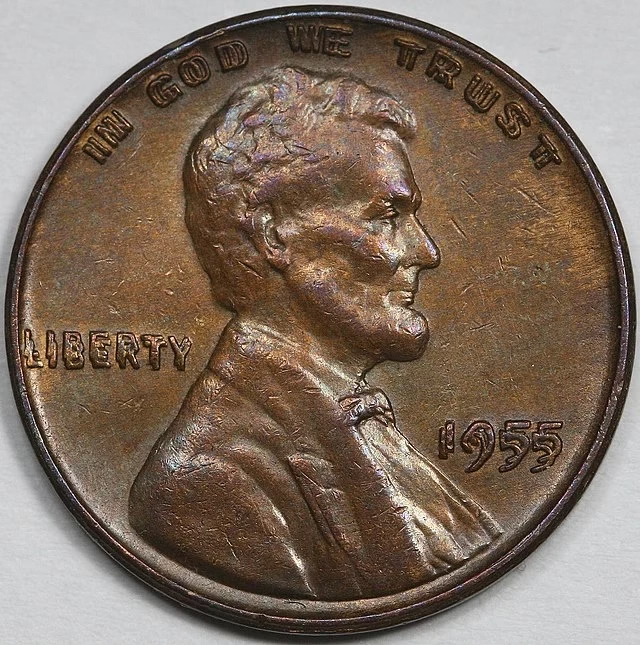
Minting errors are mistakes made during production, and they can make a coin extremely valuable. A famous example is the 1955 Double Die Lincoln Cent, where the date and lettering appear doubled, often valued at $500-$1,000 in Good (G-4) condition and up to $20,000 in Mint State (MS-65). This error occurred when the die (the stamp used to strike coins) was misaligned during production at the Philadelphia Mint, creating a striking visual effect. The doubled date and “LIBERTY” are visible to the naked eye, but a loupe helps confirm the error. I missed a similar error on a 1969-D penny early on because I didn’t inspect closely—it could have been the 1969-S doubled-die version worth $500 in Fine condition. The image I selected for this section likely shows the 1955 Double Die Lincoln Cent—look for the distinct doubling on the date and lettering to identify similar errors in your pennies.
Common Errors to Look For:
- Double-Die Errors (Doubled Designs): Beyond the 1955 Double Die, the 1969-S Lincoln Penny with a doubled-die error is another example, worth $35,000 in MS-65. The doubling on “LIBERTY” and the date is subtle but noticeable with a loupe.
- Off-Center Strikes (Design Not Centered): When the design is misaligned, like an off-center 1969 Kennedy Half Dollar (shifted 10% or more), it can be worth $50-$100 in circulated condition. Look for coins where the design doesn’t align with the center—sometimes the date or rim is partially missing. I found an off-center 1965 Washington Quarter once, shifted about 15%, and it was worth $25—a small but exciting find.
- Missing Elements (e.g., a Missing Letter or Date): A 1970-S Jefferson Nickel missing the “S” mint mark (a filled die error) can be worth $50-$100. Check for missing or faint elements in the design.
- Wrong Planchet Errors: A 1943 Steel Penny struck on a copper planchet (meant for 1942) is a rare error, worth millions—one sold for $1.7 million in 2010. Most 1943 pennies are steel (worth 10-50 cents), but a copper version weighs 3.11g instead of 2.7g, which you can confirm with a digital scale.
How to Spot Errors: Use a magnifying glass to inspect your coins for anything unusual, like blurry text, misaligned designs, or missing elements. Compare your findings to images of known error coins online—PCGS and Numista have galleries of errors to reference. We’ve covered specific error coins in posts like “Rare Quarters: Hidden Treasures Worth a Fortune,” where we highlighted valuable U.S. quarter errors, such as the 1965 Washington Quarter with a clipped planchet (worth $20-$50). Practice by examining your pocket change or coins from bank rolls—you might find a hidden gem like I did with that off-center quarter.
Step 4: Evaluate the Coin’s Condition
A coin’s condition, or grade, is a major factor in its value, as collectors prize well-preserved coins. Grading is done on a scale from Poor (P-1) to Perfect Mint State (MS-70), with each grade reflecting the coin’s wear and preservation. For example, a 1964 Kennedy Half Dollar in Very Fine (VF-20) condition—showing clear details but light wear—might be worth $15 due to its 90% silver content, while the same coin in About Uncirculated (AU-50), with minimal wear, could fetch $20. In Mint State (MS-65), near-perfect condition, it might be worth $50 or more. Similarly, a 1804 Draped Bust Dollar in Poor condition might still fetch $1 million due to its rarity, but in MS-65, it sold for $7.68 million in 2021, showing how condition amplifies value.
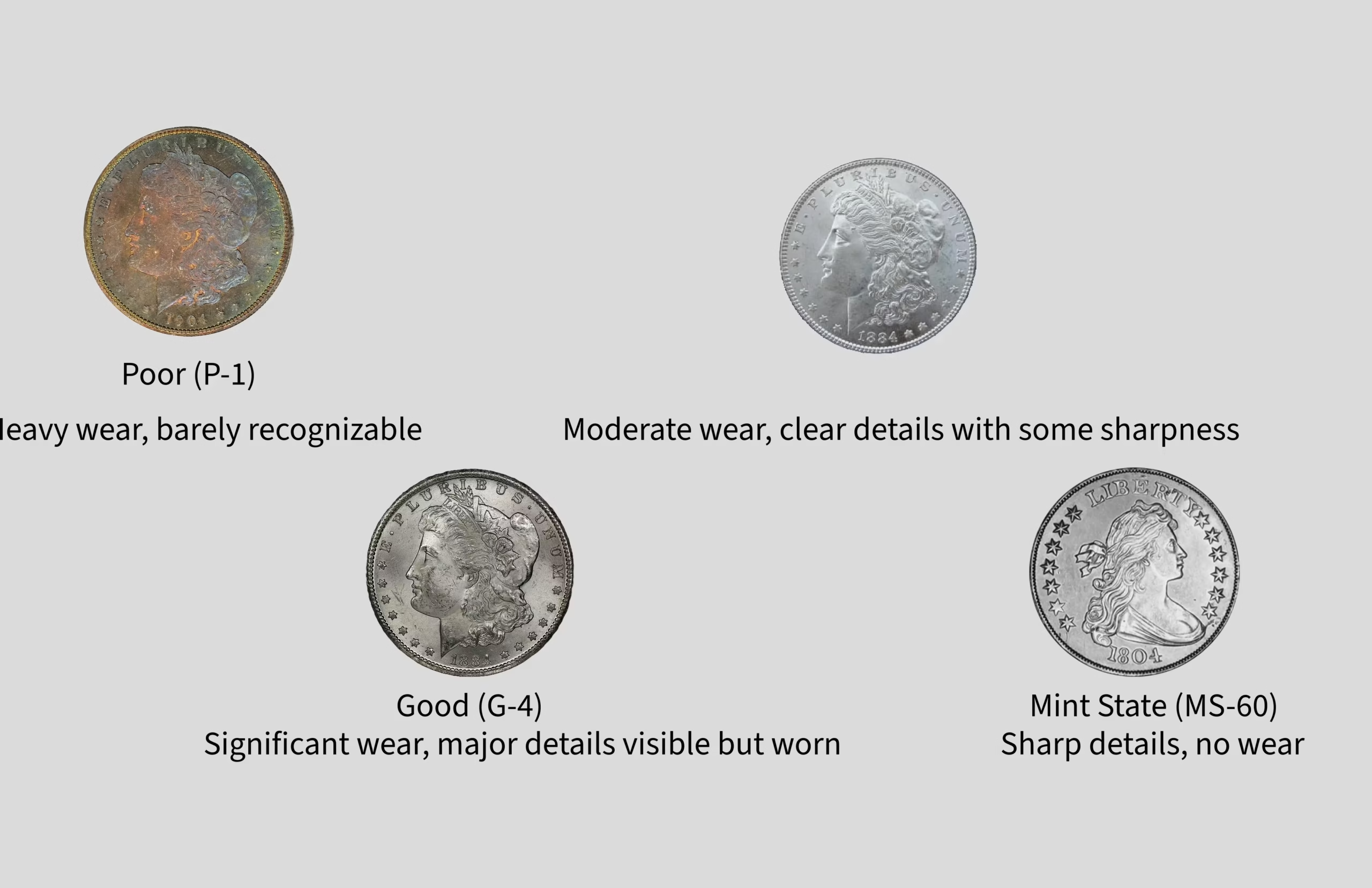
How to Assess Condition: Look for signs of wear, scratches, or discoloration, especially on high points like hair on a portrait or leaves on a wreath. On a Lincoln Penny, check if the wheat stalks on the reverse are worn or sharp—worn stalks indicate a lower grade like Fine (F-12), while sharp details suggest AU-50 or better. On a Kennedy Half Dollar, examine Kennedy’s hair—faded lines mean VF-20, while sharp details mean AU-50. I once thought a 1964 Kennedy Half Dollar was AU-50, but the worn details on Kennedy’s hair showed it was VF-20—grading takes practice. Use apps like PCGS CoinFacts or NGC (free) to compare your coin’s condition to standard images, which list values by grade. The image I included for this section likely shows a 1964 Kennedy Half Dollar in VF-20 condition—note the slight wear on Kennedy’s profile, which helped me learn to grade accurately.
Be careful when handling coins to preserve their condition—use cotton gloves (under $5) to avoid oil damage from your fingers. I learned this the hard way after smudging a 1965 Canadian Silver Dollar, which dulled its luster. Cleaning coins can also reduce their value by stripping the natural patina collectors prize, so avoid polishing unless necessary. Check out our guide “How to Clean Coins Safely in 2025: Guide for Collectors” for tips on preserving your coins without damaging them—like using distilled water and a soft brush instead of abrasive cleaners.
Step 5: Use the Right Tools
To make identifying valuable coins easier and more accurate, you’ll need a few basic tools as a beginner. These essentials help you inspect coins, research their value, and confirm their authenticity, ensuring you don’t miss a hidden gem.
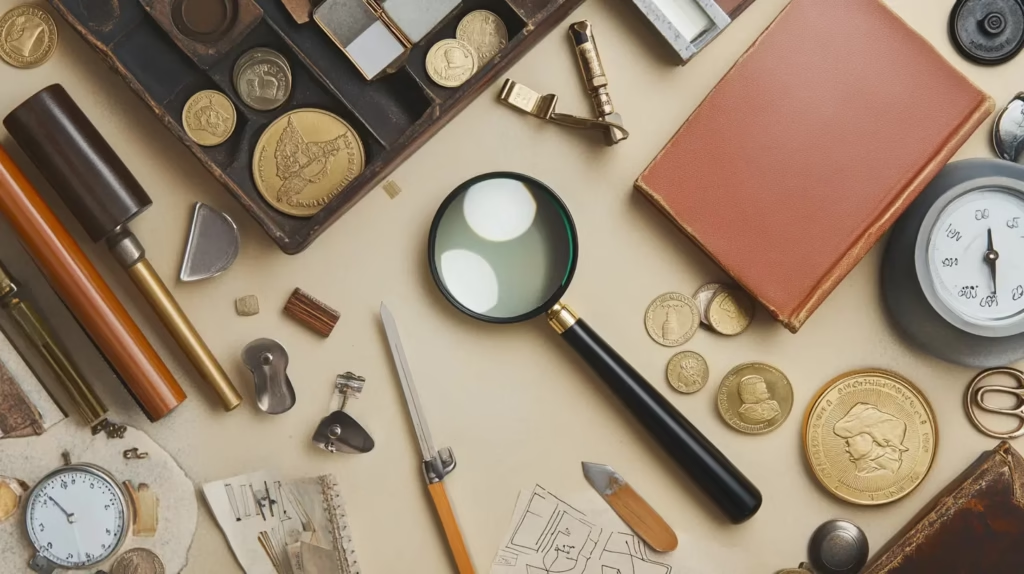
- Magnifying Loupe: A 5x or 10x loupe (around $10 online) helps you see small details like mint marks, errors, and wear. I use a 10x loupe to spot the beads variety on a 1965 Canadian Silver Dollar—it’s essential for confirming errors like doubling on a 1955 Double Die Lincoln Cent. Hold the loupe close to your eye and the coin about an inch away to get a clear view, and inspect in good lighting to avoid missing details.
- Reference Books: The Red Book (A Guide Book of United States Coins, ~$15) or the Standard Catalog of World Coins are great for beginners. The Red Book lists mintages, grades, and values for U.S. coins—I used it to confirm a 1804 Draped Bust Dollar’s rarity, which matched the image I chose for the rarity section. The Standard Catalog covers international coins, helping me value a 1965 Canadian Silver Dollar at $15-$20 based on its silver content.
- Digital Scale: Weighing a coin can help spot fakes or errors (e.g., if it’s the wrong weight). A digital scale (under $15) is precise to 0.01g—I confirmed a 1964 Kennedy Half Dollar weighed 12.5g, matching its 90% silver composition, ruling out a counterfeit. For comparison, a 1943 Steel Penny should weigh 2.7g, while a rare copper version weighs 3.11g, a difference that could mean millions.
- Online Resources: Websites like the Professional Coin Grading Service (PCGS) and Numismatic Guaranty Corporation (NGC) offer price guides and databases of rare coins. PCGS helped me identify the value of a 1955 Double Die Lincoln Cent in F-12 condition ($500), and NGC’s database confirmed varieties of the 1965 Canadian Silver Dollar, like the Small Beads, Pointed 5 type (worth $25-$50). These sites also have images of errors, making it easier to compare your coins—like the doubled-die example in our errors section.
- Digital Apps (Bonus): Apps like PCGS CoinFacts or the NGC app (free) provide grading guides and value estimates on your phone. I use PCGS CoinFacts to check a coin’s grade by comparing its wear to standard images—it’s how I learned a 1964 Kennedy Half Dollar was VF-20, not AU-50. These apps are especially useful when exploring coins from around the world, as we discussed in “The 100 Most Valuable Foreign Coins to Collect in 2025.”
These tools will help you master how to identify valuable coins as a beginner, giving you the confidence to spot value in any coin you come across. Start with a loupe and the Red Book, and add digital tools as you grow—they’ll make your collecting journey more rewarding. They’re especially useful when exploring coins from around the world, as we discussed in “The 100 Most Valuable Foreign Coins to Collect in 2025”.
Conclusion
Learning how to identify valuable coins as a beginner is a foundational skill that will make your coin-collecting journey even more exciting. By focusing on rarity—like the 1804 Draped Bust Dollar—mint marks, errors—like the 1955 Double Die Lincoln Cent—and condition, and using the right tools, you’ll be able to spot treasures in your collection, whether they’re U.S. quarters, Australian 50-cent coins, or rare Canadian pieces. At Treasure in Coins, we’re here to support you every step of the way. I still remember the excitement of finding my first valuable coin—a 1964-D Kennedy Half Dollar worth $15—and I can’t wait for you to experience that thrill too. Have you found a valuable coin yet? Share your story with us, and explore more numismatic tips on Treasure in Coins—like our Beginner’s Guide to Coin Collecting: 5 Steps for 2025 or Top 5 Coin Cleaning Mistakes to Avoid in 2025. Don’t forget to sign up for our weekly newsletter (in the sidebar or footer) to get updates, tips, and inspiration delivered to your inbox. Your next valuable find could be just a coin away—happy collecting!
Frequently Asked Questions
What makes a coin valuable?
A coin’s value usually comes from its rarity, condition, minting errors, and historical significance. Coins with low mintage or unusual features tend to be worth more.
How do I know if a coin is rare?
Start by checking the year and mint mark. Then look for errors, odd materials, or coins from a short production run. Online databases and coin price guides can help.
Can damaged coins still be valuable?
Sometimes, yes. If the damage is from a minting error (not post-circulation wear), it might actually increase value. But generally, cleaner coins are worth more.
Should I clean a coin before checking its value?
No—cleaning a coin can reduce its value significantly. It’s best to leave it as-is until you know what you’re dealing with.
What tools can help me evaluate coins?
A magnifier, soft gloves, reference books, and online guides like PCGS CoinFacts or NGC Explorer are great starting points for beginners.